

Howdy! This is just a little (and much belated) behind-the-scenes essay about my latest short story, By A Road We Do Not Know- here I’ll cover the research, inspirations, writing process, cover art, and a bunch of other stuff that went into writing this.
Obviously spoilers abound, so if you haven’t read the story already you can do so below:

Research & Inspirations
This story was conceived as a sister project to my paleo-vignette collection, Chicxulub. While that collection was as scientifically accurate as I could make it, I wanted this companion piece, also set on the last night of the Cretaceous, to have a far more “retro” feeling.
See, when I was growing up in the early 2000s, the field of paleontology was at a sort of transition point between the older, cold-blooded currents of 20th century interpretations of dinosaurs and the modern trend toward feathery, intelligent ones. If Chicxulub was a tribute to the cutting edge of dino-science, By A Road We Do Not Know is a love letter to all these dusty old ideas a much smaller version of myself eagerly devoured from library books and scratchy VHS tapes.
I’ve also always been a big fan of the Silurian Hypothesis- the idea that other species as intelligent as humans have flourished and then gone extinct throughout Earth’s history. Thus, while Chicxulub was a very naturalistic look at the extinction as normal animals might have experienced it, here a prehuman sophont is the protagonist, relaying a more mythic, narrative version of the event.
The tone, however, was meant to be just as somber and complementary to Chicxulub, and in this I believe I was entirely successful.
I am far, far, far from the first person to explore the concept of intelligent species existing in the Cretaceous, but I had a ball writing it nonetheless. Some specifics regarding the world presented in the story follow-
Rilk’s People
I make no claim as to the plausibility of Rilk’s people existing. It’s a trope that was commonly featured in dinosaur documentaries when I was a child, most often depicting the uncanny “dinosauroid” conceived by paleontologist Dale Russell and sculpted to life by Ron Séguin as a possible “what if?” evolutionary path which may have been taken by the brainy dinosaur Troodon if the extinction never happened. Usually the sculpture was shown in an evocatively darkened room, eerily obscured by the dim lighting.
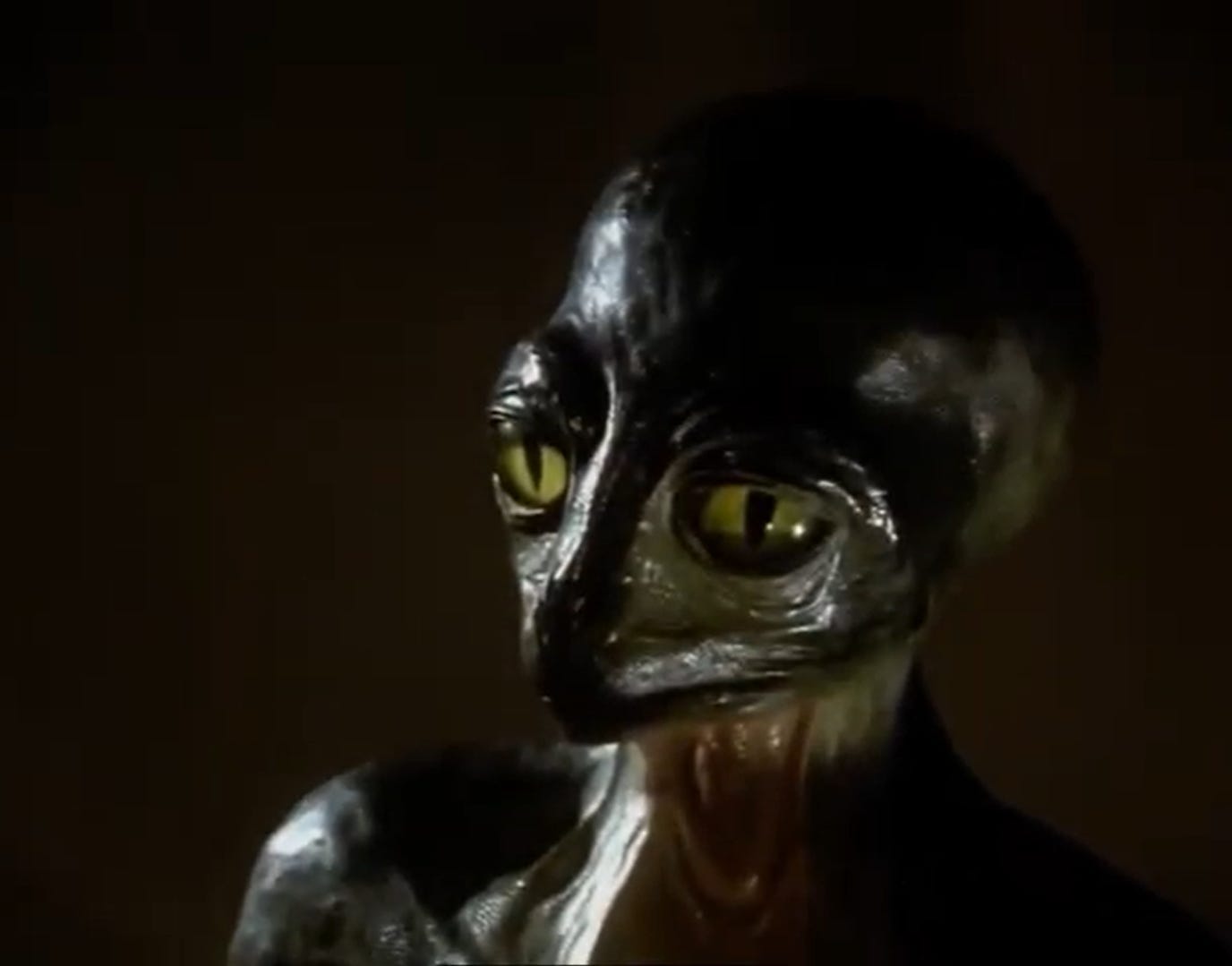
Now, in real life, it is highly unlikely any theropod dinosaur would evolve a humanoid bauplan like this. There would simply be no need for Troodon to alter its form so dramatically to become a tool user, as it already possessed perfectly functional grasping hands.
More recently, C.M. Kosemen and Simon Roy created their own far more plausible version of “dinosauroids” which retain a more traditional theropod bauplan. You can read Russell’s original 1982 paper proposing the dinosauroid here, and view Kosemen & Roy’s project here.


That said, since I was already going for a vintage tone to this piece, scientific accuracy was not my top priority and I was happy to make a humanoid reptile my protagonist.
I’m still uncertain if Rilk’s people are actually dinosaurs or not- it’s never specified in the story, but I see them being more related to other reptiles like iguanas or crocodilians. Their multicolored eyes were based on geckos, and their ability to change color depending on their emotions is obviously chameleonesque, but nowhere is it written that dinosaurs didn’t possess such traits too1. Since Rilk’s people hadn’t quite gotten to inventing taxonomy yet when their existence was brought to its tragic end, I suppose it’s a moot point. I leave it for you to decide, dear reader.
Regardless, the fantastic Wayne Barlowe painting I modeled Rilk and his people from (more on that below) seemed like a happy medium between the two extremes of Russell’s fully humanoid dinosauroid and Kosemen & Roy’s more plausible take on such a creature. It’s nice and vintage, which fit perfectly with my stated goals for the story.
As stated, a big inspiration for the story was the Silurian Hypothesis, which posits that if another industrial species existed more than ten million years ago we would have zero way of knowing it other than by traces of synthetic plastics, chemical pollutants, and radionucleotides in the sediment. Some legacy, huh? Every monument, every artifact, every hint that they ever built would have long since been ground to dust in the patient hands of Time2.
Someone like Rilk’s people, who are only at a Neolithic technological level with limited subsistence agriculture, would be almost completely undetectable in the rock record. Fossilization is extremely rare, so it’s entirely possible that a low-population group would pass into oblivion without leaving any fossil record. We don’t even have that many good fossils of our own species from the Pleistocene, and that only ended eleven thousand years ago- think of how many dinosaurs must be missing from our museum collections, after all those hundreds of millions of lonely years.
In short, while it’s not impossible that someone like Rilk walked the Earth in the twilight of the Mesozoic, this story obviously isn’t claiming that anyone did.
A More Vintage Cretaceous
As stated above, I deliberately gave the Cretaceous world of By A Road We Do Not Know a very “retro” description. This is most obvious among the dinosaurs, all of them being cold-blooded lizards dragging their tails on the ground when they walk. None of them are described as having feathers, save for the briefly mentioned “sicklewings”, and they are all quite brainless.
While we know today that this is all terribly inaccurate, such ideas were the popular scientific consensus throughout most of the 20th century, and some of it was still in vogue or hotly debated even into my own childhood. I grew up in the early 2000s, so I sort of got the “best of both worlds” of both older paleontology and the latest science, as they clashed and mingled with each other.3
For instance, while the notion of semiaquatic hadrosaurs and sauropods- both of which appear in By A Road We Do Not Know- was recognized as false over a decade before I was born, it was still depicted in media often enough for it to form an integral part of my childhood conception of these animals. It was almost like there were two very different “kinds” of them living in my head- there were the real sauropods that shook the ground, and then this other, more primeval kind that spent most of their time up to their shoulders in the swamps, and both were equally real to me even though I knew even then that only the former actually existed on this Earth once upon a time.
I also chose to depict the extinction itself somewhat anachronistically. When I was a child, the theory most in vogue for the extinction of the dinosaurs was that the asteroid finished them off, but there were only a handful of species left and they were already on their way out the door, due to a variety of factors- there was mass volcanism in the Deccan Traps, mammals were eating all their eggs, they were suffering from new diseases to which they had no immunity, and newly evolved angiosperms were snuffing out their gymnosperm food supply.
Today, much like with the biology of the dinosaurs themselves, we know that virtually none of this is true. The dinosaurs were thriving on the eve of the comet. They had long since adapted to angiosperms, and had been coexisting with mammals for over a hundred and sixty million years when their time came. Nevertheless, I cannot deny that this “vintage” model of their demise holds immense charm, and I still like it quite a lot. So, aside from the Deccan volcanism, I included all of these as details in the story. The didels are referred to as repulsive egg-thieves, ivy is an invasive weed among Rilk’s people, and flowers are so strange and new they don’t even have a name for them yet. It made for a nice, evocative little world that I didn’t spend nearly as much time in as I would’ve liked. But then, that’s the whole point of the story, isn’t it? It was a perfect world for Rilk’s people, but it is nevertheless ending, asteroid or not.
Some obvious inspirations for the story- many of which receive little winks and nods in the narrative- included The Land Before Time, Fantasia, Walking With Dinosaurs- specifically the last episode, Death of a Dynasty- and books such as The Last Dinosaur by Jim Murphy, The Ultimate Dinosaur by Preiss & Silverberg, and way, waaaay too many educational dinosaur textbooks to list.


Several of the depicted dinosaur genera were given common names of my own coinage, since Rilk’s people obviously would not know Triceratops by that name, any more than a medieval Englishman would know a stag by its scientific name Cervus elaphus. A brief glossary of these common names is provided below:
Dreadfang- Tyrannnosaurus
Thornface- Triceratops
Stoneback- Ankylosaurus
Stryta- Ornithomimus
Broadbill- generic hadrosaur; the name is a play on our colloquial term “duckbill”, as ducks don’t exist yet in Rilk’s time.
Long-neck- generic sauropod- you really shouldn’t need me to tell you this one, but it’s here for the sake of completion.
Sicklewing- a temporally displaced Archaeopteryx; the real animal lived in the Late Jurassic a hundred million years before Chicxulub. Nevertheless, in old-school paleontology books it was iconic as the “bird-like dinosaur” and thus earned its place in the story as a sort of pet/status symbol among Rilk’s people.
Dreadclaw- Deinonychus, which is here portrayed as a traditionally scaly, Jurassic Park style cheetah-lizard.
Dactyl- not dinosaurs but generic pterosaurs- very creative, I know
One last creature that also wasn’t a dinosaur were the generic small mammals that decide to take a bite out of Rilk at the end of the story- the didels. The name was rather unimaginatively lifted from Didelphodon, a small genus of metatherian mammal which, ironically, went extinct at the end of the Cretaceous, along with most other mammals.
Chicxulub Science
For all the story’s intentional inaccuracies, I did include some more scientifically accurate elements as well, mainly relating to the after effects of the Chicxulub impact, which was about as bad as I described. All the forests in the world were lit on fire almost simultaneously, and photosynthesis completely ground to a halt for between two and five years after the impact. Any large animals that survived the initial firestorms either starved or froze to death.4
One thing that might seem out of place is the rapidity of the extinction, with the dinosaurs all dying out after a mere three weeks. It’s certainly probable that in reality some species persisted for several bleak months after the impact, until they finally starved or were choked by all the ash. But remember, all of the dinosaurs in By A Road We Do Not Know are cold-blooded, so it was more the freezing temperatures that killed them than hunger.
Speaking of freezing, Rilk’s astonishment at the existence of ice isn’t out of place at all. It’s debated what exactly the climate was like in Hell Creek at the end of the Cretaceous, but it probably never snowed. Very infrequent, once-a-century flurries, at best. In the story of course, the region is depicted as nearly tropical, which is probably hotter than it really was.
The almost random blossoming of fern seeds that Rilk awakens to one morning, and their swift expiry, was a late addition to the story. This probably did happen, as did the later bloom of fungi- as I discussed at some length in another essay here- though they probably lasted a little bit longer than the mere hours I depicted in the story.
But the coolest accuracy, in my view, is the timing of the impact, because we actually know when the asteroid hit. Without getting too into the weeds on it- because I could spend the rest of the essay discussing just this- it is now widely believed that the Chicxulub asteroid impacted early in the boreal spring. We know this thanks to fossil fish found at a site in North Dakota called Tanis, which almost impossibly was laid down within an hour of the impact. The fish had microtektites, eject from the asteroid returning to Earth, trapped in their gills as they struggled to breathe, and the growth rings in their bones suggest they were just coming out of a lean winter.
Again, I can’t really get more into this here because I will talk about it forever. Please just understand that this is by a wide margin the least likely fossil deposition to ever happen. But it did. It exists.
Anyway, dragging my excitement back to my story, the Feast of the Planting Sun that Rilk was supposed to procure fish for is a reference to the March Equinox, roughly coinciding with that early boreal spring impact range.
Writing Process
By A Road We Do Not Know took a long time to write. I wrote it semi-concurrently with The Gytrash- another one that took a real darn long time to finish- and set it aside for quite awhile, hauling it out for occasional editing when I was lagging on other projects. Both of these stories suffer from similar issues. For one, I certainly overindulged in flowery metaphors- a weakness which I promise I’m trying to reign in a bit. Another was character. I’m still not quite satisfied with the strained father-son dynamic Rilk and Irano had… it’s serviceable, but it doesn’t feel first-rate, if that makes any sense.
Regardless, when I finally hauled it out for the last time about two weeks before publication, it actually held up a lot better than I’d thought and didn’t require that much work. Only a few brief scenes were added- the seedling bloom, the ghosts of Irano and Naoma beckoning Rilk up the hill- and the rest was just tidying up the prose and moving a few scenes around. This last bit took the longest amount of time, mostly affecting some stuff towards the beginning of the story that I couldn’t bear to cut but didn’t fit where it was anymore. About 99% of it was salvaged in some way, so there wasn’t any wasted effort here.
If there’s any lesson I learned from By A Road We Do Not Know and The Gytrash it’s that if you’re unsure of a story’s merit, just stuff it in the drawer for a few months. When you dust it off later you’ll gaze on it with more honest eyes- flaws you missed in the thick of things will stick out sharp as splinters, but overall you might find it’s not as bad as you’d thought.5
Cover Art
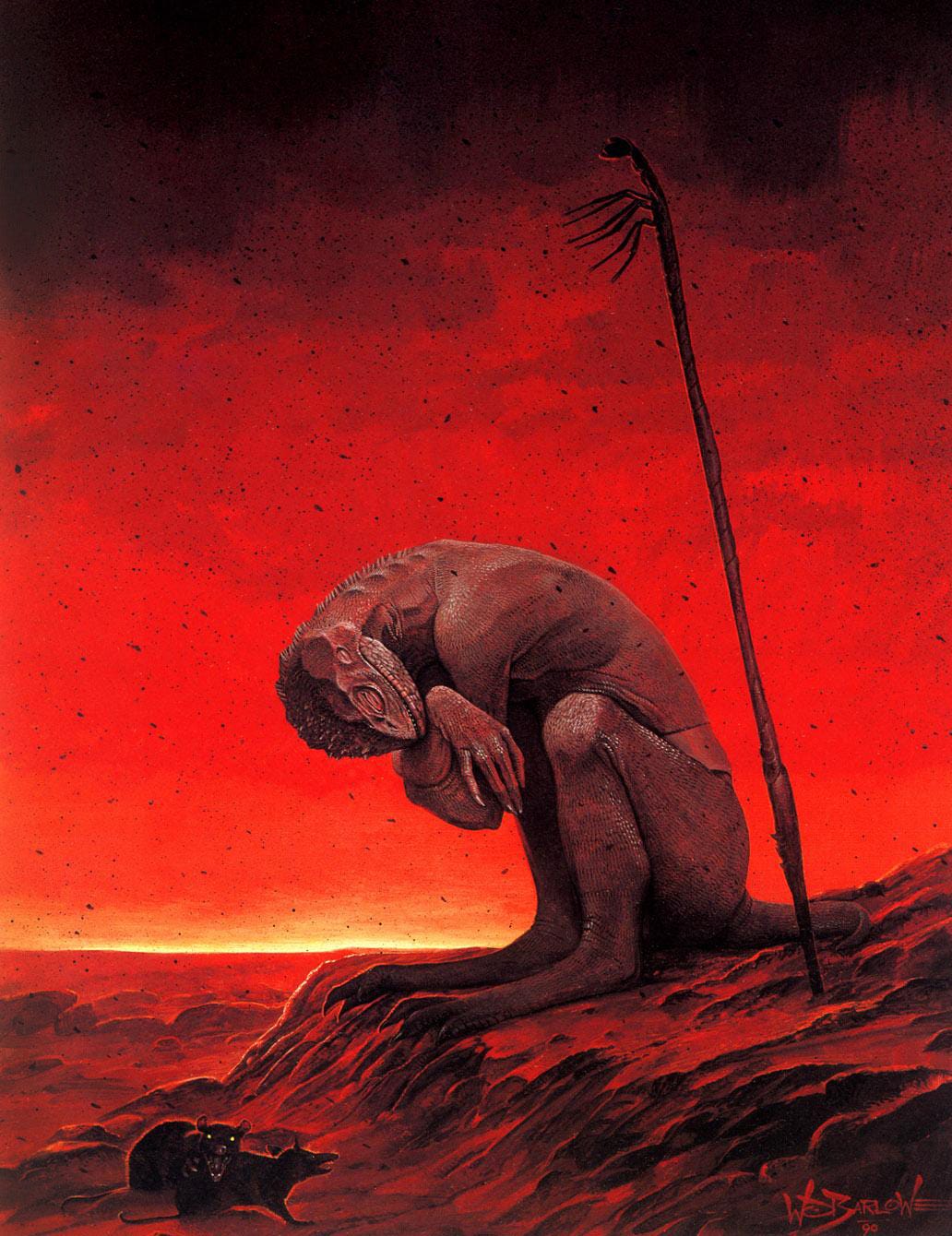
The cover art for the story is a fantastic piece by Wayne Barlowe, titled Dawn of the Endless Night. That was actually my working title for the story when I began writing it, and it remained the title until quite late in development.
About halfway through the writing process, I learned that there was already another story by Harry Harrison going by that title, which was also written specifically to accompany this painting. The Harrison story is quite good, and I recommend reading that one as well. Unfortunately, its just claim to the title necessitated changing my own. I was at a loss for awhile, until I recalled an essay I wrote some years ago about the exploits of General Custer’s Crow Indian scouts at the Battle of the Little Bighorn. After Custer ignored the scouts’ warnings that he was badly outmatched, one of the scouts, Half Yellow Face, told Custer- “You and I are both going home tonight by a road we do not know.”
Shopkeeping
Just a real quick aside, I know my publishing schedule has been pretty erratic lately. I’ve been hard at work trying to finish writing a novel which has forced me to sideline many other projects meant to be published here- including this very essay, which was mostly done the same week By A Road We Do Not Know was published, and then stuffed in a drawer to make time for the novel! I’m still working on the other stories on the side… I simply have no idea when they’ll be done…
Anyway, if I go radio silent for a bit longer, it’s nothing to be concerned about, I’m simply abusing my keyboard.
I hope- for those of you who made it this far- that this wasn’t too boring a read, or that it felt overly indulgent. I always enjoy when other writers and artists discuss their own techniques and inspirations, so I figure there’s a small chance you guys might enjoy hearing a bit about mine.
That’s all. You can go home now.
Yes, it is actually entirely possible that dinosaurs could change color like chameleons. Some extant crocodilians are known to be capable of this, though not to such kaleidoscopic extremes as chameleons, or Rilk’s people for that matter.
It’s not impossible for certain structures to last a long, long time- Mount Rushmore and the Giza Pyramids might last over a million years if they are buried by volcanic ash or desert sands, respectively. But even they would eventually be ground into the dust, and it is EXCEEDINGLY improbable that any Cretaceous-era Mount Rushmore would still be discoverable today.
My parents’ lack of knowledge about dinosaurs helped broaden my exposure considerably- they didn’t care much if a dino documentary VHS tape was ten years out of date, all that mattered was if it had dinosaurs in it because I liked dinosaurs.
This is true even considering that dinosaurs were warm-blooded. Warm-blooded does not equal polar-adapted; if you dropped a Sumatran Rhinoceros into the Yukon, it would swiftly expire.
Hardly an original thought, but a truth spoken a thousand times is better than one never spoken at all.