

Heads Up: this edition of “WRITING OF” contains some grotesque medical imagery. Viewer discretion is advised, yada-yada.
Minor Shopkeeping Note- I used to post these “writing of” essays over on my other blog, Poquessian, however I’ve decided to switch to publishing them here on my main blog. The first few of these will be free “taste-testers” but I am planning to eventually paywall such behind-the-scenes content, while the stories themselves remain free to read by all. Cheers!
Howdy! This is just a little behind-the-scenes essay about my latest1 short story, The Bone Baby- here I’ll cover the research, inspirations, the cover art, writing process, and a bunch of other stuff that went into writing this.
Obviously spoilers abound, so if you haven’t read the story already you can do so below:

Inspirations
The Bone Baby was directly inspired by the Twitter post below-
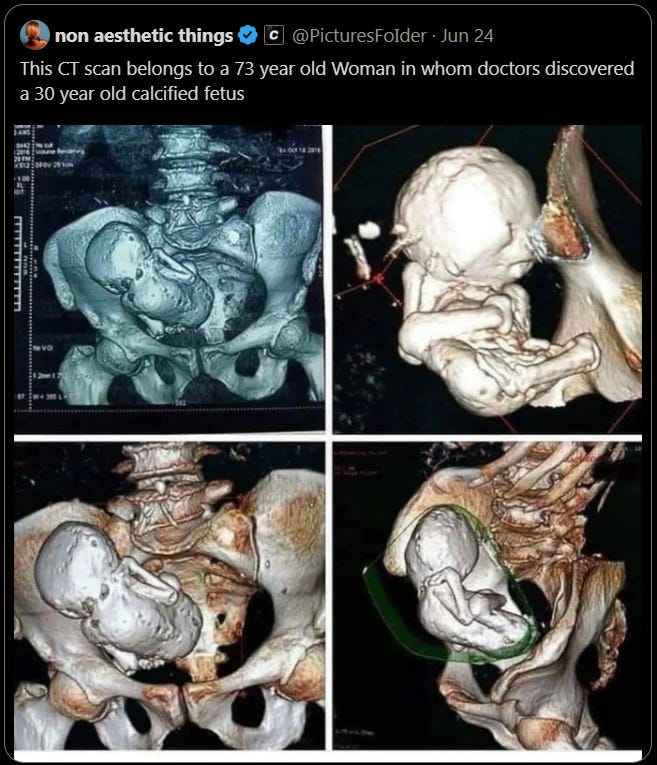
My immediate response to this, aside from “That’s awful” was “This is the start of a horrible old-timey fairy tale.” Because I’m a writer whose Muse went mad long ago, and I can’t help but see story potential in even the worst real-world tragedies.
I followed up this initial thought by writing the following one-sentence horror story:
"- and after the Bone Baby burst out of his mother's belly, he traveled all over the countryside, peeking into all the cradles in all the cottages, looking for more baby bones to steal."
The story crystallized instantly from this into the tale you’ve just read.
Setting
The Bone Baby is my second attempt at writing an “American fairy tale”, with my first try at this being The Severed Head. Similar to The Severed Head, The Bone Baby is set during the pre-Revolution colonial era in Pennsylvania, this time in the Philadelphia region, where I was able to blend all kinds of local geography, history, and folklore into the tale you’ve just read.
The story starts out in the southern environs of Philadelphia, specifically in the region once known as “the Neck”. This was the swampy, southernmost part of the Philadelphia peninsula back in the day, and remained a very poor, rural area focused on raising pigs right up until the 1920s. I won’t get all into the history of the region here for brevity’s sake, but Hidden City Philadelphia had a fantastic series on it some years ago, which provided the backbone of my description.
Today, it’s mostly a sea of parking lots, warehouses, and railyards, and is home to all of Philadelphia’s sports teams. So nothing’s really changed I suppose.


The bulk of the action in The Bone Baby, however, occurs in a place known as “the Timber Swamp”, in what is today Northeast Philadelphia. This is also a real location, described briefly in the book A History of the Townships of Byberry and Moreland, written in 1867 by Joseph C. Martindale-
Timber Swamp. This is a large tract of wood land reaching from the west corner of Byberry near Andrew Ervein’s, northeast along the Moreland line almost to the Somerton road. This was formerly one vast tract of woodland, the largest in the vicinity, and was a noted hunting ground. Raccoons, opossums, squirrels, and birds were found there in abundance, and even bears were sometimes seen. The last Bruin found there was in 1780, and was shot by Jersey Billy Walton. It was formerly a great place for ghosts, &c., and many marvellous tales have been narrated as occurring in the “timber swamp.” Much of the timber has been cleared off within a few years, and its limits thereby greatly contracted.
The Timber Swamp, at least some fraction of it, still exists today, not terribly far from my own home. Only about 93 acres of it are left, but it is some of the “wildest’ land left in Philadelphia, with no neatly paved park trails to navigate by. It’s a fun- and somewhat dangerous2- place to explore, being hemmed in by a residential neighborhood, the terribly congested Byberry Road, and the CSX tracks running like a spine through the northeastern half of the city.


While the Timber Swamp itself may survive for now3, to my knowledge tragically none of the tantalizingly alluded “marvellous tales” are still extant. The Bone Baby thus is my attempt to, in some small way, revive this old, hyperlocal ghost-tale tradition.
Today, I can lay claim to the dubious title of being the most recent person to tell a “marvellous tale” set in the Timber Swamp, and perhaps I am also the most recent person- possibly only person in the 21st century- to even think about the marvellous tales of the Timber Swamp.
Research
Very little original research was required for this story, which expedited the writing process considerably. Mostly I just had to brush up on stuff I’d already read a long time ago, as an avid fan of local history and folklore.
We’ll go over the research which went into some of the individual characters first, before going on to the origins of the magical items in the story, and finally the Bone Baby itself.
Ape Boy
The Ape Boy in the first third of the story is a real character from Philadelphia-region legend. I hesitate to call him a “cryptid” due to his supernatural origins, but he is still seen occasionally to this day. I’ve written about him at length before in the essay linked below, and this probably won’t be the last time he shows up in one of my stories.

tl;dr this gangly redheaded boy was bullied so viciously that he ran away into the swamps and turned into a Bigfoot. The End4.
For storytelling purposes, I transplanted his “habitat” a bit eastward into the Neck, which as stated was still really swampy at the time the story is set. Assuming the Ape Boy existed, I could see him having ventured over into South Philly at least occasionally, but from a purist folkloric standpoint this was a bit of artistic license on my part.
The main divergence from the real-life tale of the Ape Boy is he did not have a witch mother and is not known to have romanced any poor country girls. He just ran off into the woods and mutated into a Bigfoot-esque monsterman. I added all of that in as tragic backstory for the Bone Baby’s accursed existence.
The Ape Boy’s mother is just a typical fairy-tale witch, though Philadelphia does have a couple of real witch-stories- Mom Rinker, Margaret Mattson- which helped to lend a level of verisimilitude to this unnamed fictitious one.
Nathan and Samuel
Nathan was very straightforward to write- he’s just the typical, plucky child protagonist of folk and fairy tales the world over. A bit unsure of himself, but by the end of the story he’s confident and skilled enough to face the Bone Baby one-on-one.
Samuel required a bit of research into childrearing in early America. Firstly, this was set long before baby formula existed, so it was a bit of a hassle trying to figure out how he would be fed on the multi-day journey to Bristol without mother’s milk. The solution turned out to be pap.
Pap was formula-before-formula- a soft mush made out of bread or flour soaked in either milk or water, sometimes flavored with honey. It was delivered to the baby via a pap boat, which was basically just a gravy boat meant to be tipped directly into the baby’s mouth. Usually these were made of pewter or bone china, but wealthier families could have their cast from sterling silver. Nathan’s family, being on a lower rung of the socioeconomic ladder, likely would have used a pewter one, similar to the ones below:


Some further reading on pap and pap boats can be found here and here.
I was also uncertain about how colonial Americans carried babies around over long distances, and had to research this a bit. Apparently the English tradition brought over was swaddling, carrying the baby over one’s back in a grubby looking cloth sack or sling.
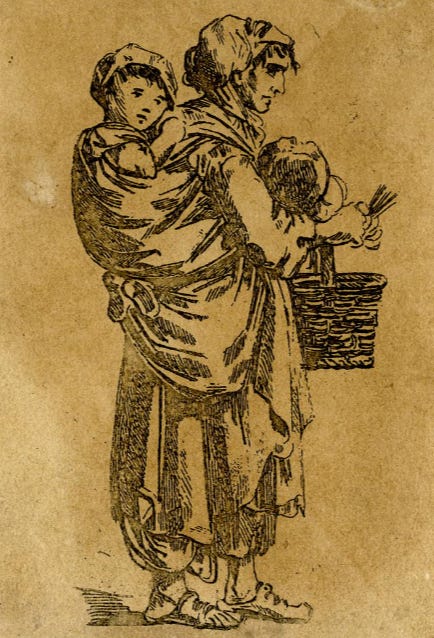
I much preferred the American Indian style papoose over such haphazard-looking sackcloths, and chose to have Samuel carried around in one of those instead. It made for a somewhat tighter narrative, with the papoose being an easily removable backpack rather than a complicated sling, and it also fit well with Nathan’s mother being in contact with the Lenape, whom she could conceivably have picked up the idea from. I don’t know if any real colonial American women ever did this- it seems improbable that none ever did- but it fit within the framework of the story.
Rattlesnake Joe
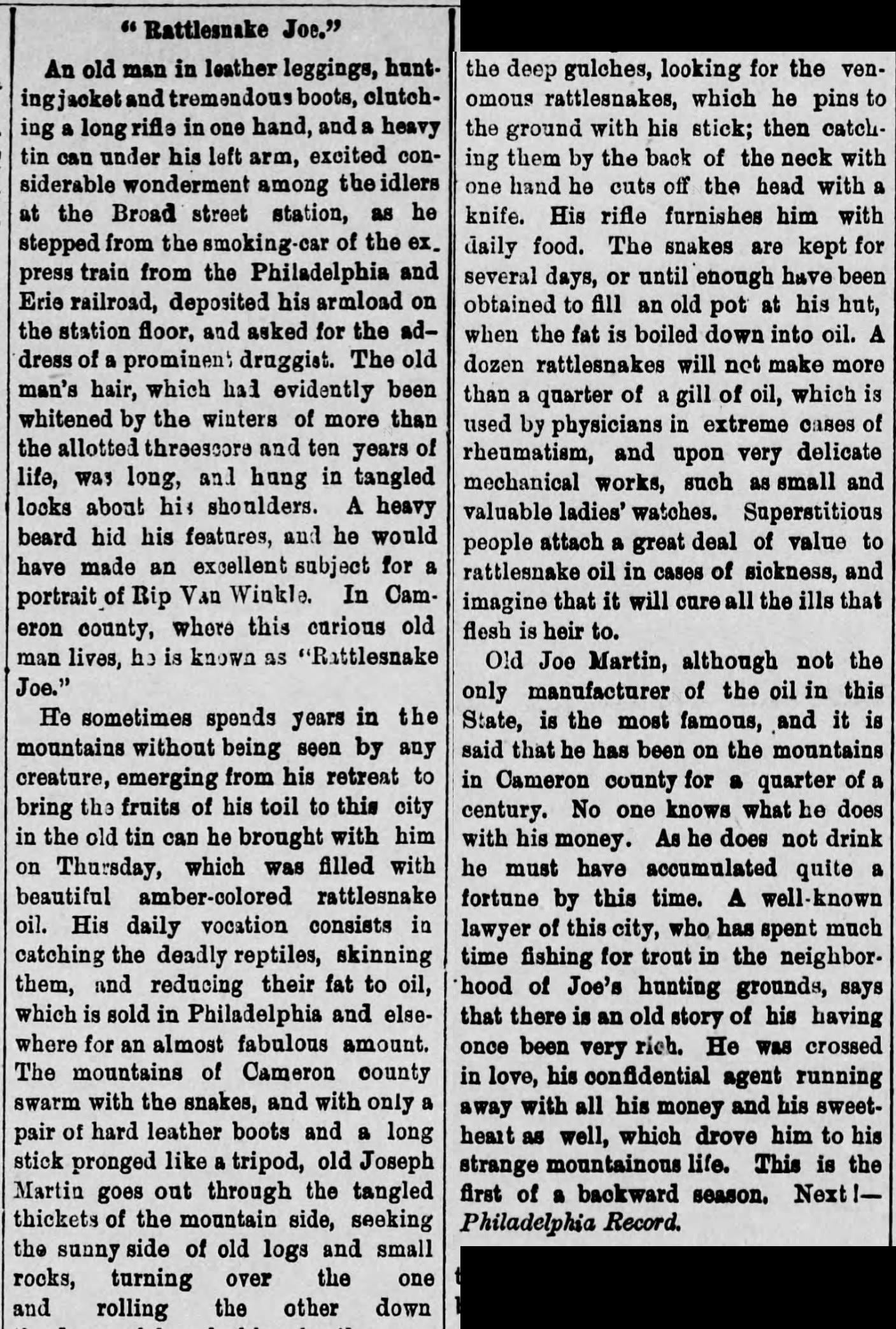
Rattlesnake Joe was based on several historical figures- chief among them being… Rattlesnake Joe, whom I read about in a book titled Forgotten Tales of Philadelphia, by Thomas & Edward White.
Joseph Martin, nicknamed Rattlesnake Joe, was a hermit who lived in the rugged ridge-country of Cameron County, Pennsylvania in the mid- to late-1800s, where he trapped the region’s abundant rattlesnakes to render them into snakeoil, which was used for medicinal purposes and as a mechanical lubricant. This mysterious old man would only ever come out of his mountain abode on rare occasions to sell his much-renowned snakeoil. We only have record of his existence due to one such trip he took to Philadelphia in 1882, disembarking a train at Broad Street Station looking to all the world like an antebellum version of Rip Van Winkle- his clothes thirty years out of date, his long white hair and beard all disheveled, and carrying nothing but an old tin can full of vials of amber rattlesnake oil.
The real Rattlesnake Joe was a teetotaler, and was also rumored to have once been very rich due to the profitability of his snakeoil business, only to lose it all when his sweetheart absconded with all his hard-earned treasure. I considered including a lost fortune and lost lover in the story to flesh out my fictional Rattle, but there simply wasn’t room for such backstory without interrupting the narrative flow.
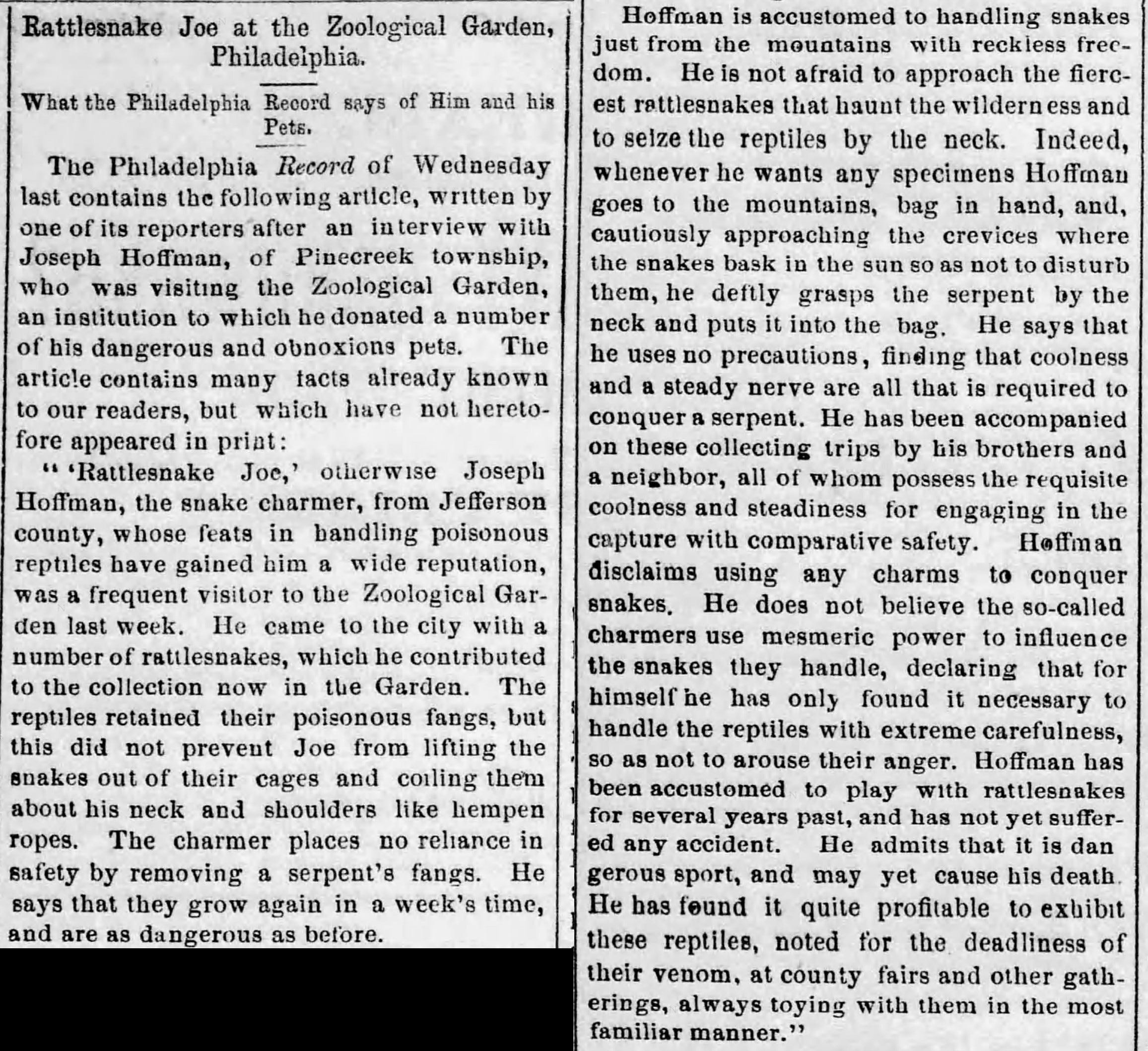
Oddly, while following up on the blurb from Forgotten Tales of Philadelphia, I came across another Rattlesnake Joe- or maybe the same one, and one of the reporters just got his facts wrong? This one, identified as Joseph Hoffman of Jefferson County, Pennsylvania, was reported in November of 1882 as having visited the then-new Philadelphia Zoo, to donate a bunch of rattlesnakes he had captured over the years.
This Joe was not as much of a hermit as Martin, collecting the rattlesnakes with the aid of his brothers and a neighbor, and prior to this visit to Philadelphia had made his money not from the snakes’ oil, but by playing with them as a sideshow at county fairs. He was reported to have had iron nerve while handling them, and that’s all he said is needed to manage the reptiles- maintaining a cool confidence so as to not provoke their own fear. He did, however, say the sport might eventually result in his own death, and since there’s no followup article we’ll probably never know how things turned out for him.
Another rattlesnake-wrangler from Pennsylvania- it seems to have been something of a national pastime- was Rattlesnake Pete, from Erwinna, Bucks County. I learned about him from a blurb in Forgotten Tales of Pennsylvania, also by Thomas White. Pete was also an old hermit, who lived in a shack in the hills above Erwinna, alone save for his dog and a bunch of pet rattlesnakes which roamed freely around his shack.
According to an article in the New York Times, as a child Pete lived in Sussex County, New Jersey, where the rattlesnakes were “thicker than bees in honeytime,” so he had to learn real quick how to read their body language and kill them if necessary. He lost a friend to a snakebite, and nearly lost his sister and his own life in one hair-raising encounter where the pair had to contend with half a dozen rattlers at once while they were out picking berries. Later in life he learned how to tame rattlers, and had no fear whatsoever of his scaly pets, which he loved as dearly as his dog.
Followup research on Pete mostly led to dead-ends. Apparently he made a bit of business out of two caves he’d discovered on his property, one containing white clay and the other a big clot of ice- priceless in a time before refrigeration- but beyond this there were only two articles from the New York Times locked away behind paywalls.
One final Pennsylvania rattlesnake-wrangler was… another Rattlesnake Pete, this one from Oil City. His overall life story wasn’t that relevant to Rattle’s character- he became internationally famous running two very successful dime museums in Oil City and Rochester, New York- but his origin story inspired how I wound up introducing Rattlesnake Joe in my own tale:
He would later claim, that, while a boy hiking in the local hills, he had come upon an old Indian woman from the Seneca reservation. Dragging behind her on a rope a big dead rattlesnake, she explained to Pete how she would extract the fatty oil, which was used to treat rheumatism, stiff joints, even earache—among other afflictions. Impressed by the boy’s interest, she even gave him the snake’s skin. Pete later learned from the Indians how to capture the rattlers, and from the medicine men how to use them for various folk remedies.
These four figures composed the main “brew” of Rattle’s character. Aside from these real men of history, the characters of Puddleglum from Narnia and the Shaggy Man from The Road to Oz also were of notable influence in developing Rattle’s character, with his introduction containing a shoutout to the Shaggy Man specifically. Both of these odd, kindly loners are my favorite characters from their respective series, and it was a lot of fun writing my own version of such a character.
In hindsight, I do wish I had been able to include more backstory for the character, but regrettably there wasn’t anywhere to put it.
Magic & Talismans
The magic and talismans present in the story are all rooted in real legends and traditions.
Rattlesnake Joe mentions his rifle being “blest” by a powwower- this was not a reference to American Indian powwows, but rather to the Pennsylvania Dutch folk magic system of braucherei, also confusingly referred to in local vernacular as powwow. Among the Pennsylvania Dutch, the use of magic was highly structured and wasn’t considered always evil like in most other parts of Europe and America. There were good magic users, the braucherei/powwowers, while hexerei/witches were evil magic users. Brauchers regularly gave battle to hexers with… mixed results. I’ll certainly be returning to this magic system in future stories, as it’s criminally underexplored in fiction.
The idea of Rattlesnake Joe’s bullets being enchanted is also a real component of traditional American magical lore. There are at least two stories I’m aware of where blessed silver bullets were used in an attempt to destroy a witch- one by Loop Hill Ike up in northern Pennsylvania was successful, while another by Webb White in Crisfield, Maryland comically wasn’t. Both of these stories involved killing witches directly, but I figured it wouldn’t be that great a stretch to use enchanted bullets to destroy a monster created via a witch’s magic.
The biggest difference between my narrative and these two is that the real witch stories involved shooting an effigy of the witch first- Loop Hill Ike shot a voodoo doll fashioned after the witch’s likeness, while Web White shot a drawing of her. In my story, Nathan just shoots the Bone Baby directly. This was artistic license on my part.
Parenthetically, this was also my attempt to introduce firearms into a fantasy setting- I don’t understand why we still have basically no fantasy whatsoever with guns. There are plenty of ways to work firearms into a fantasy setting without removing one iota of magic, as I hope I’ve successfully demonstrated here.
Each of the three talismans Nathan’s mother5 gives him were inspired by real magical artifacts.
The Blue Bottle was based off of a real enchanted bottle carried around by an Irish “cunning woman” named Biddy Early. This bottle, which really was blue, was purportedly used to observe far-away events, almost to the point of comedy- it was said that if a traveler had come to meet Biddy, she would spy his approach in the bottle and go out to meet him halfway. The bottle had many other powers too, but for The Bone Baby’s purposes only one was necessary to the plot. The whole “and the bottle can only be used once by a muggle” thing was artistic license on my part.
The real Blue Bottle was never seen again after Biddy’s death, and a few different legends have sprung up around this- one version says that the bottle was on loan from the faeries, who took it back upon Biddy’s demise, while another claims that an irate priest hurled the “bewitched” bottle into a lake, where it waits to this day for someone to find it.
The Snakestone Amulet was an ammonite. Ammonite fossils were commonly unearthed in medieval Europe, and were called snakestones because they were believed to be proof of the actions of saints- for instance, Saint Patrick, or Saint Hilda of Whitby who allegedly turned a bunch of snakes to stone.
Ammonites were also used as talismans by North American Indian tribes, most commonly out in the “old west” region, which once was the shallow Western Interior Seaway. They went by many names- bacoritse to the Crow, kaittcolcooko to the Hopi, iniskim to the Blackfeet, etc.- and were used extensively in magical rituals and as talismans. Many of the chiefs at the Battle of the Little Bighorn, for instance, wore ammonite talismans to protect them from their enemies.
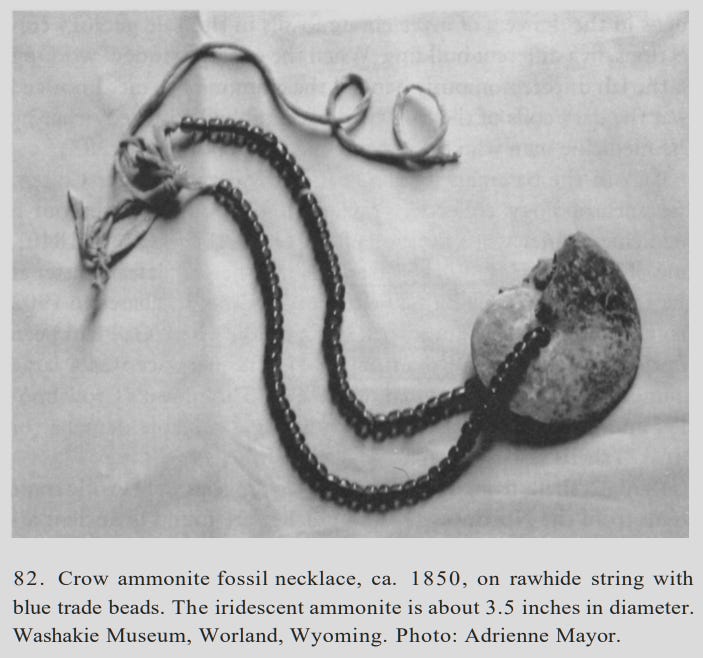
I’m not aware of any specific fossil-lore regarding ammonites among eastern Indian tribes, but you can find ammonites in Pennsylvania and New Jersey if you look in the right places, so it’s certainly not impossible for there to have been a legend or two about them. My thinking was that the ammonite talisman came from out west via long-distance trade networks- such a rare and unusual item would obviously be of high value, and it would make sense for Nathan’s superstitious English mother to trade for one. I considered this a cool way to “link” European and Amerindian fossil lore together.
Rattle’s knowledge of the true identity of the snakestone was artistic license on my part- I very much doubt any living person at the time had an inkling of how vastly ancient fossils truly were. I put that scene in there as a deconstruction-cum-reconstruction of magic. No, the ammonite is not magical because it was once a snake that was petrified by God in the Flood. Yes, the ammonite is magical because it is the sacred ghost of a created being that existed in this world long, long before us, preserved for us “as perfect[ly] as if a Divine hand had stamped [it] in yielding wax.”6
Finally, chalk is of course well-known for its “sealant” properties in magical lore and has appeared in a plethora of other media for the exact reason Nathan uses it. Smearing the circle ruining the enchantment is also something that appears in the lore, and that detail made for a delightfully tense climax.
Chalk is also technically a fossil- it is composed entirely of prehistoric marine microorganisms like plankton and diatoms that sank down to the bottom of the sea and were crushed over the ensuing eons into something we can use to draw on sidewalks or blackboards. I considered this another neat way of linking prehistory to folklore.
Ultimately, the tools Nathan uses to defeat the Bone Baby are also the bones of things, and his weapons prevail partly because they are an older and deeper and purer magic than what the witch used to create the Bone Baby.
All in all, this was the most fun part of the story to write- setting up specific rules for the usage of magic and then working within these confines was a riot, really enjoyed that challenge and think it turned out swell.
Real Bone Babies & Other Skeletal Horrors
Finally, the Bone Baby itself was inspired by a couple of grotesque medical conditions, the first of these being the aforementioned CT scan of the ossified fetus. That isn’t the first time such a thing happened- it’s common enough that such “stone babies” have their own medical term, lithopedions. The most recent one on record, per Wikipedia, was in 2020. The oldest known lithopedion was dated back to 1,100BC, and was discovered during an archaeological dig at a sinkhole in Texas7.
The condition is quite rare- only three hundred cases are known over the past four centuries of medical research. It requires several “just right” conditions to occur. One, lithopedions can only form during an abdominal pregnancy. This rare subtype of ectopic pregnancy- wherein the baby develops in the abdominal cavity completely outside of the uterus- has a roughly 1 in 11,000 chance of occurring. Then of these already small odds, less than 2% of these are predicted to result in lithopedion formation, because the fetus has to develop enough in this hostile environment that it is too large to simply be resorbed into the mother’s own body.
The lithopedion itself is the calcified remains of the fetus. The mother’s immune system reacts to it as a foreign intruder and basically transforms the deceased baby’s body into bone, to protect her from any septic infection that might be wrought by the decaying baby’s tissue.
What’s really creepy is women usually aren’t aware of having a lithopedion inside them for years to decades after. They’re often only detected accidentally, usually during X-ray or CT scans after complaints of persistent abdominal pain. On average, women carry lithopedions for 22 years before realizing something isn’t right, with a mean diagnosis age of 55. The oldest woman to have a confirmed lithopedion was a centenarian; nine women carried their calcified babies for over fifty years. There certainly have been many others which went completely undiagnosed, so there are caskets in cemeteries right now which, unbeknownst to any but God, contain two skeletons.
Also, several women with lithopedions went on to have several successful pregnancies too, after the lithopedion formed! That’s incredibly creepy! Imagine growing in the womb, listening to your mother’s heartbeat, learning her laugh before your eyes even opened, and the whole time you are blissfully unaware of the ossified grimace of your elder sibling leering at you through the thin uterine wall, envying the safety and comfort which they were so cruelly denied…
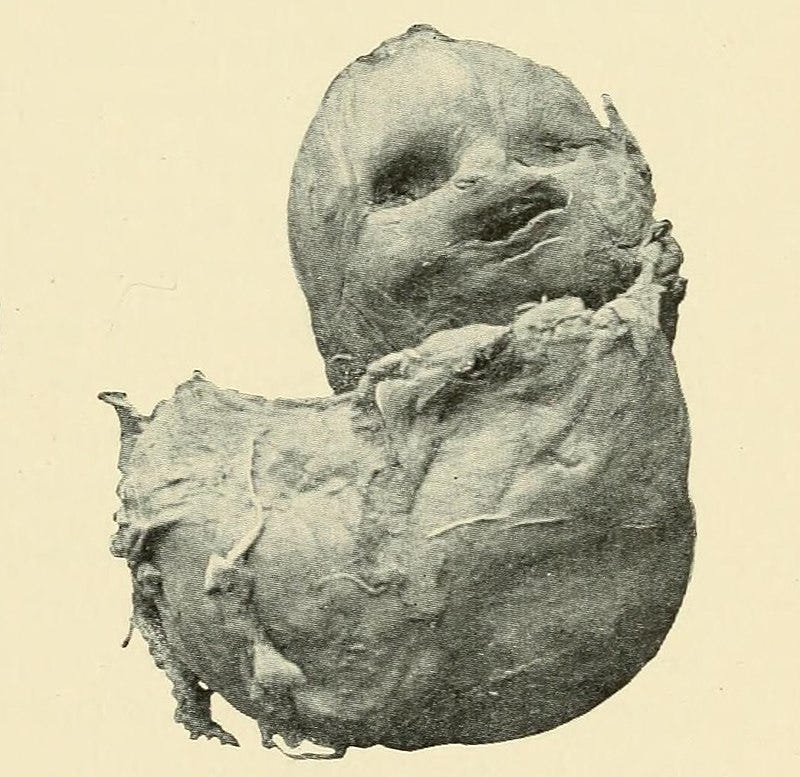
Another condition which inspired my description of the Bone Baby’s appearance is fibrodysplasia ossificans progressiva. This absolutely dreadful genetic disease causes all connective tissues in a person- that’s the muscles, tendons, and ligaments- to slowly ossify. Your muscles and joints fuse into bone. It’s a terrifying and heartbreaking illness- life expectancy for victims is usually only around 40, and the victims will often try to find comfortable positions to spend the rest of their lives in once the disease reaches its dreadful conclusion.
The most famous victim of FOP is probably Harry Raymond Eastlack, who died of the disease when he was 39. He donated his skeleton to the Mütter Museum in Philadelphia. I was regrettably unable to visit the museum in preparation for this story, but there are plenty of photos of him online which were very helpful to the visual design of the Bone Baby.
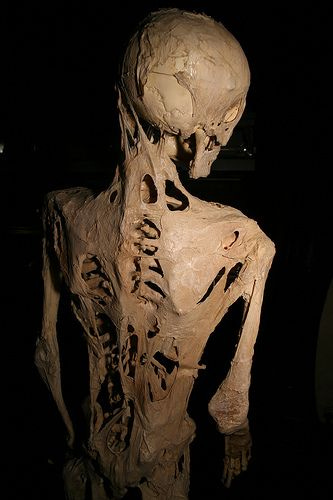
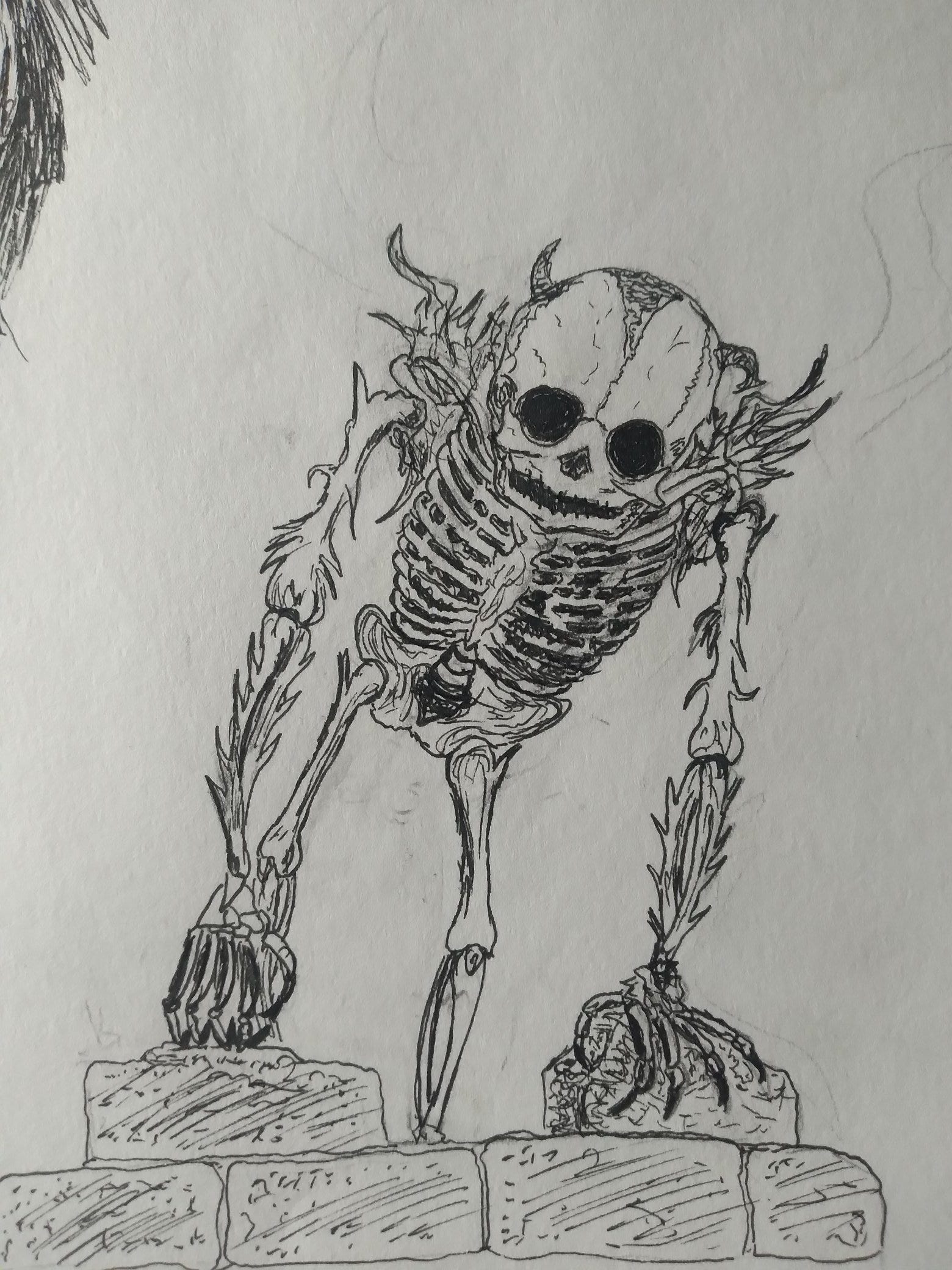
I didn’t want the Bone Baby to just be a menacing skeleton, like the ones so excellently portrayed by Ray Harryhausen in Jason and the Argonauts. I wanted the Bone Baby to be truly monstrous, and the disconcertingly ossified muscles and tendons of FOP was perfect to this end. It also enabled me to show what exactly the Bone Baby was doing with the baby bones it was stealing- growing more bone for itself!
Some other visual references for the Bone Baby’s design included the skeletonized witch Roleil from Fire & Ice, the Pale Man from Pan’s Labyrinth, and the Fair-Haired Child from Masters of Horror.
With all this in mind, this is how I imagined the Bone Baby looking:
The circumstances of the Bone Baby’s birth are of course reminiscent of another famous local legend, the Jersey Devil, with both originating in curses, both being born monstrous, and both immediately going on killing sprees.
The main difference is that the Jersey Devil’s curse was self-inflicted by his mother- he was her thirteenth child and, according to who’s telling the story, either when she found out she was pregnant again or in the midst of her labor pains she exclaimed “let this one be a devil!”, and that’s all she wrote. The Jersey Devil also, depending on the telling, either did or did not kill his mother8, but he most definitely did kill all of his siblings before flying up the chimney. Just his siblings though; he did not then go on a rampage against all the children of the region as my Bone Baby did.
And no, I have no interest in describing how the Bone Baby steals baby bones. I know you were dying to know the entire story, and the answer is no. I have my own idea of it, but whatever you’ve imagined is surely far worse.
Analysis
I loved writing this story. It was honestly the most fun I’ve had writing a story in a long time. Combining so many aspects of local history and folklore- both deeply passionate interests of mine- was a romp, and even though the finished story is far from the greatest thing I’ve ever written, I like it for what it is.
Specifically regarding its fairy tale style, I think in certain ways it’s an improvement upon The Severed Head, and in others a regression. I don’t know; it’s a very difficult style to pull off properly. It transitions from more traditional fairy tale prose at the beginning, with Patience and the Ape Boy, into more of a folk-tale style for the main action, and concludes in almost Baumian fashion at the celebration. That’s three different styles throughout. I’m not entirely satisfied that I blended them effectively, but the story stands well enough.
Most likely, I will not write another fairy tale for some time. None of my currently planned projects are fairy tales, but we’ll see. This one came to me all of the sudden, and so may another.
I hope- for those of you who made it this far- that this wasn’t too boring a read, or that it felt overly indulgent. I always enjoy when other writers and artists discuss their own techniques and inspirations, so I figure there’s a small chance you guys might enjoy hearing a bit about mine.
That’s all. You can go home now.
This essay was written awhile back, right after finishing The Bone Baby, but I delayed publishing it until actually drawing a sketch of the titular character. Thus, The Bone Baby is no longer my “latest” short story at the time of publication.
Over the years it’s become a minor drug hangout and occasional dumping ground for bodies.
Though it is constantly threatened with new development…
Who among us hasn’t been there?
Her name in the original draft was “Hester Woolston” but I cut this in favor of simpler fairy-tale naming conventions.
The Life of a Fossil Hunter by Charles Hazelius Sternberg
Sequel potential, anyone?
In some more wholesome versions of the story he was actually an upstanding son, checking in on Mother Leeds from time to time and presumably disemboweling anyone who was nasty towards her.