

Minor Shopkeeping Note- I used to post these “writing of” essays over on my other blog, Poquessian, however I’ve decided to switch to publishing them here on my main site, while that one will be relegated to nonfiction essays on various subjects. The first few of these behind-the-scenes essays will be free “taste-testers” but I am planning to eventually paywall such behind-the-scenes content, while the stories themselves remain free to read by all. Cheers!
Howdy! This is just a little behind-the-scenes essay about my latest short story, The Hide-Hunter- here I’ll cover the research, inspirations, the cover art, writing process, and a bunch of other stuff that went into the story.
Obviously spoilers abound, so if you haven’t read it already you can do so below:

Research & Inspirations
This story came to me in the shower. It was completely, fully-formed in a single instant as I lathered my hair in shampoo while thinking about passages from two books- the chapter on the senseless slaughter of the American Bison related in Dan Flores’ Wild New World, and the American Indian traditions of “stinging men” and “buffalo calling stones” reported by Adrienne Mayor in Fossil Legends of the First Americans.
The story was born in that chance criticality event where I wondered- “what if a former hide hunter was cursed to be killed by a ghost herd of the same buffaloes he so greedily consigned to extinction?” Even before I climbed out of the shower and dried myself, the creative gears where already spinning at full speed, and I wrote down a quick plot outline which rapidly matured into the story you’ve just finished reading.
From that point, all I had to do was reread the relevant passages from those books, as well as a chapter of Flores’ preceding book American Serengeti, and certain chapters of Charles Hazelius Sternberg’s autobiography The Life of a Fossil Hunter. Below, I will recount in brief the main historical elements of the story.
Fossil Hunters
The most natural protagonist for a story involving cursed fossils is of course a paleontologist; indeed, this might be the only sort of individual on the planet capable of delivering such a curse’s dramatic consequences upon its victim, no matter how accidentally this was accomplished.
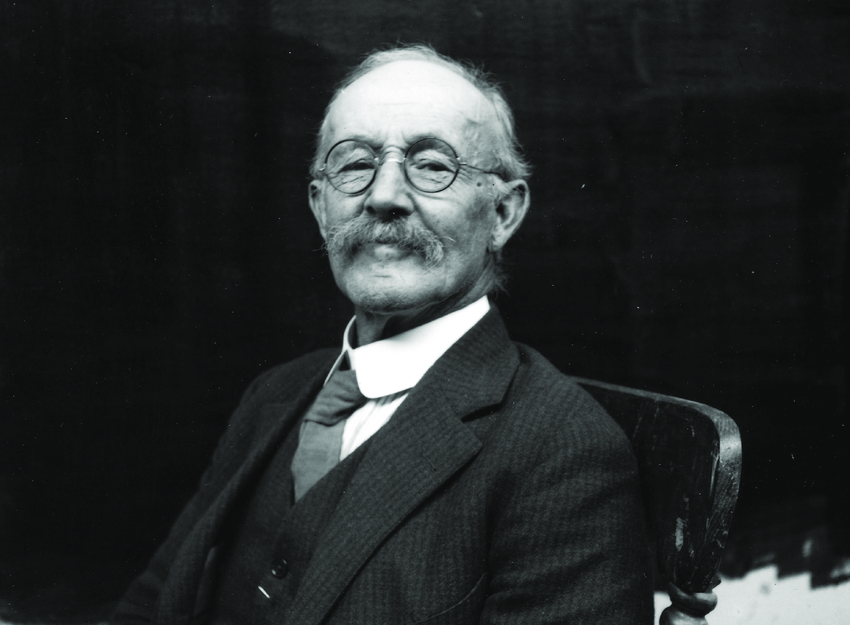
The character of the fossil collector Joseph Yarnall was largely based on Charles Hazelius Sternberg, a Kansan fossil collector whose career spanned from 1876 to 1928. For brevity’s sake I must limit my remarks, because I could wax for many lines on what a remarkable man he was. Suffice to say, Sternberg was the sort of man whom you instantly recognize as your better, in the best possible way. One is almost tempted to put aside his voluminous scientific discoveries- and without him, many of the prehistoric creatures we know and love today might never have become as justly famous as they are now- just to admire him as a man. He was brave, he was kind, and he was deeply passionate about his love for the wonders of Creation and all the worlds that came before us, even at considerable risk to his own health and safety.
I highly recommend reading his autobiography, The Life Of A Fossil Hunter. Perhaps the most remarkable incident of heroism recounted in those pages is when he and his team were caught in the crossfire of the Bannock War in 1878, an Indian uprising in Idaho. Sternberg, in an odd, paleontological twist on Horatius’s defense of Rome from the Etruscans, valiantly insisted on dragging his heavy crates of fossils to safety even when the Red Man was bearing down upon his camp, because he believed preserving that wealth of the ages for the benefit of future generations was more important than saving his own hide. He was an incredible man and a total badass.
I found the strong biophilia Sternberg evinces throughout his autobiography not only deeply commendable, but also a perfect contrast to the greed of Hedgepeth and the real-life hide hunters who inspired him, which I tried to adapt somewhat into Yarnall’s character-
If I ever had any feelings of disgust or fear toward any of God's creatures, I lost them upon a knowledge of the animals as revealed to me by this master naturalist, who saw beauty even in lizards and snakes. He believed, and taught me to believe, that it is a crime to destroy life wantonly, any life. Of course the first law of nature is self-preservation; we must, in order to live, kill our enemies and protect our friends; but this superstitious fear which men and, even more, women have of snakes, lizards, and bugs, how cruel it is! Why should they rejoice when some poor little garter-snake, which has gone as a friend into the cellar walls to destroy rats and mice, is dragged out and cut to pieces? My heart bleeds when I think of the brutal way in which people take life, something they can never give back, and with the great Cope, I cry out against this crime, which is exterminating some of our most beautiful and useful friends. No man can say he loves us, when he wantonly destroys our work; no man loves God who wantonly destroys His creatures.
Another relevant passage-
What is it that urges a man to risk his life in these precipitous fossil beds? I can answer only for myself, but with me there were two motives, the desire to add to human knowledge, which has been the great motive of my life, and the hunting instinct, which is deeply planted in my heart. Not the desire to destroy life, but to see it. The man whose love for wild animals is most deeply developed is not he who ruthlessly takes their lives, but he who follows them with the camera, studies them with loving sympathy, and pictures them in their various haunts. It is thus that I love creatures of other ages, and that I want to become acquainted with them in their natural environments. They are never dead to me; my imagination breathes life into "the valley of dry bones," and not only do the living forms of the animals stand before me, but the countries which they inhabited rise for me through the mists of the ages.
What a beautiful mindset. Sternberg’s profound appreciation for the gorgeous, unfathomable scale and complexity of Creation is deeply inspiring, and it is this sort of spirit which I wanted to bestow upon my character of Yarnall.
I must admit here that do not think I achieved this goal, and for that I am regretful. There was a lot more I could have done with Yarnall, but he remained a rather simplistic narrator figure throughout. In that role he is serviceable, but I feel I could have “worked” the character so much more. I held back mainly because I didn’t want Yarnall to come off as an ideological mouthpiece, and wanted more for Hedgepeth’s words and deeds to speak for themselves in the mind of the reader. Still, think I could’ve done a lot better.
Aside from this, the details of Yarnall’s expedition to the Red Beds were also inspired by Sternberg’s narrative. He was there several times. The Red Beds are real, they are of Permian vintage, and they really are that inhospitable to life. The descriptions of the detestable clay-water requiring boiling in cacti to be remotely palatable, and the cows attempting to eat cacti for moisture, are all real details gleaned from Sternberg’s narrative, as is the terrible intensity of the norther, one such of which Sternberg suffered with only a tent over his head.
Hide Hunters
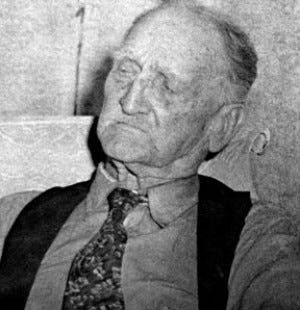
The antagonist of the story, of course, is Hedgepeth. Hedgepeth was written to be as unlikeable as possible even apart from his former occupation; yet, he’s also a tragic figure. You’re not really supposed to root for him- though, if you do, I as the author am dead and have no say over that- but you can kind of see the confluence of events that led him to where he was.
This leads us directly to the real-life inspiration for Hedgepeth, Frank H. Mayer. He wrote a short autobiographical pamphlet titled The Buffalo Harvest, which you can read here.
If ever there were a contrast to Charles H. Sternberg, it would be Frank H. Mayer. Like Hedgepeth, he was a Civil War veteran- Union, not Confederate- who went out west to seek his fortune in hunting, as he had no other marketable skills.
Mayer was the kind of caricature of a ruthless hunter you’d see in old Disney movies; the furthest possible thing from the generally more conservation-aware hunters in America today, who desire to preserve game populations from season to season. Mayer- and all the other hide hunters- just killed as many buffalo as they possibly could with gleeful abandon, solely for their personal enrichment. Every word Hedgepeth utters about the buffalo being “gold pieces” and “what was good for me was good for America” is true to how these men felt and wrote in their own words. I encourage you to read The Buffalo Harvest- it’s a rare glimpse into the mind of a disgustingly greedy man who didn’t care a fig about posterity. He died two months short of his 104th birthday in 1954, outliving the market hunt by 71 years, but the bison thus far have outlived him by 72 years, and may they continue to do so for many more.
Unlike Hedgepeth, and even many real hide hunters, Mayer evinced absolutely zero remorse for his actions-
It wasn't long after I got into the game that I began to realize that the end for the buffalo was in sight. I resolved to get my share. I went into the business right. I invested every cent I owned in an outfit. I have no apologies for my participation in the slaughter. I hope that answers the question.
One thing about Mayer’s narrative that inspired Hedgepeth’s speech is that it is chock-full of contradictory justifications for his role in the demise of the bison. I don’t know that he was ever remorseful for it in his heart of hearts, or if he was only trying to deceitfully convince others that he did the right thing. I think his concluding remark is correct, however-
Maybe we runners served our purpose in helping abolish the buffalo; maybe it was our ruthless harvesting of him which telescoped the control of the Indian by a decade or maybe more. Or maybe I am just rationalizing. Maybe we were just a greedy lot who wanted to get ours, and to hell with posterity, the buffalo, and anyone else, just so we kept our scalps on and our money pouches filled. I think maybe that is the way it was.
He was a truly repulsive man, but perhaps not as repulsive as John Cook, another former hide hunter who crafted an elaborate and enduring lie to justify his part in the murder of America’s most charismatic mammal- he is the one who first claimed the army was secretly behind the slaughter, out of a desire to destroy the Indian commissary. He claimed the US military was so invested in this goal they would hand out free ammunition to hide hunters, a claim repeated by Mayer, and, in the story, Hedgepeth.
There’s just one small problem with this- it’s complete fiction, about as real as my own story.
The goofiest part of it is that Cook claimed the Texas legislature, of all governing bodies, was contemplating a bill to outlaw bison hunting, only to by thwarted by an impassioned speech by General Philip Sheridan arguing for the extermination of the bison. The real Sheridan was an early proponent of bison conservation, specifically cabling Washington in 1879 to try to stop the slaughter, in order to prevent starvation and uprisings on the reservations occupied by friendly Indian tribes. His exact words were- “I consider it important that this wholesale slaughter of the Buffalo should be stopped.”
So, no, the hide hunters really were just a lot of greedy barbarians who didn’t care one iota about preserving the bison for the future. The government did nothing to stop them, of course, but this inaction does not have any relevance to the moral dimension of their own individual choices. They still made the choice to consign an entire species to extinction solely for personal financial gain. It was only thanks to the dedicated efforts of a handful of people1 that any bison are left alive at all today.
As for the actual hide hunting experience as described by Hedgepeth, I kept it as close to reality as possible- buffalo running outfits really were mostly after cows and yearlings2, they would only kill as many as their skinners could handle in a day, they would leave the meat to rot3, and it was really quite profitable compared to the living one could back “back East” for the meager handful of years it lasted.
Quoting Dan Flores, whose opinion on the matter I fully endorse-
There are two perfect words for their kind of callous disregard for life, for an attitude that regarded two or three years of returns worth leaving behind a putrid desert of rotting carcasses and blowflies and a deprived posterity.
Fucking pathetic.
Stinging Men
Gnaski, aka Crazy Buffalo, is a real, highly malevolent figure from Lakota folklore. He was supposedly the son of Unktehi, the Water Monster who ruled the world before our present age, and he is where the tradition of “stinging men” originated. Quoting from Fossil Legends of the First Americans-
Long ago, goes the story, Gnaski came upon a band of the First People traveling west along the Niobrara River to the springs. As they passed Carnegie Hill, Gnaski “grabbed up a piece of bone from the long-dead Unkte’gi monsters that laid buried there” and magically projected it into the body of a young man. Then he showed the man how to use the fossils to make powerful medicine.
Back among his people, the young man stung by the fossil bone began behaving frantically and violently, like a crazed bull. The first Lakota medicine man, Wata, managed to cure him and removed the fossil splinter from his body. Wata warned the people not to follow Gnaski’s stinging ceremony, in which a wizard could “enchant, bewitch, or cause sickness” by ritually shooting a sliver of fossil bone into another person.
If you’re unable to procure a copy of this book- which I highly recommend you do- this article from Distinctly Montana magazine is a decent summary of Plains Indian fossil traditions, also drawing from the book.4
Just like The Bone Baby, this story heavily features “fossilomancy”- a word I just made up to describe global traditions of magic revolving around fossils. The Lakota were no strangers to this sort of magic, but their traditions were a bit unusual in that they included evil fossil magic. How precisely such magic works is wisely left unstated by the Plains Indian elders, and even if I did know I wouldn’t tell you.
The location where Hedgepeth is cursed is also a reference to this legend- the Agate Springs fossil beds, preserving rich deposits of Miocene mammals, are located on the Niobrara River. The Lakota knew it as A’bekiya Wama’kaskan s’e, or “Animal Bones Brutally Scattered About” and they studiously avoided the place because the fossils there were considered wakan sica- bad medicine- to the point that they erected stone tumuli specifically to mark the boundaries of this forbidden zone. The only ones who would venture into this dark place were the H'munga Wicasa- Stinging Men- so they could go on their own malignant vision quests and gather fossils to “sting” their enemies. Even in modern times, the place supposedly retains something of a sinister energy.

In my narrative, I of course portrayed Gnaski as something more of a vengeful spirit figure. He’s not a “good guy,” per se, but while he does place a curse upon Hedgepeth, he’s not outwardly villainous either. Here, he personifies the Plains Indian zeitgeist as the bison herds vanished and the species orbited perilously close to an extinction spiral- they viewed it as the complete end of history, a nearly eschatological event with the caveat being that no one was anointed or saved. Everything just stopped when the bison died. As Crow leader Plenty Coups put it- “After that, nothing happened.”
I mean, imagine a sin so hideously evil that even the most reviled figure from your religion slithers out to lay down a curse upon its perpetrators. That’s how I wanted to portray Gnaski here. He may well have been an evil man, but he was also a Sioux, who lived by the bison, and would have missed them had they been so cruelly murdered in his own time.
Calling Stones


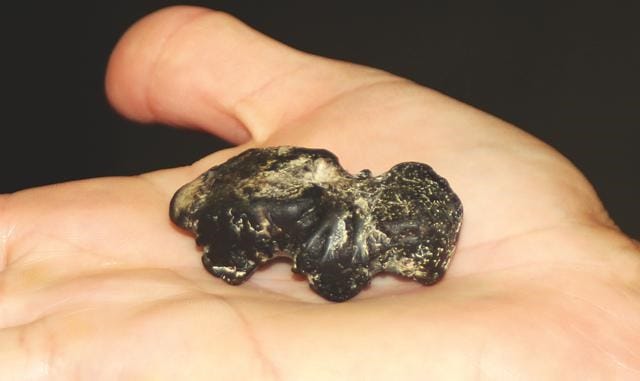
The fateful calling stone is a real part of Plains Indian folklore, and they really are little fossils, as you can see above. The description of them as impressions of the internal core of a baculite- really a subtype of ammonite- is accurate.
Quoting again from Fossil Legends of the First Americans-
Because the internal structure and patterns of these cephalopod marine fossils sometimes resemble bison shapes, the Blackfeet, Cheyenne, and other Plains tribes invested baculites with an ability to summon buffalo herds. Buffalo-calling stones, known as Iniskim among the Blackfeet bands of northern Montana and Alberta, have also turned up in archaeological sites across the Dakotas, Montana, and Canada, indicating that the Iniskim tradition goes back at least a thousand years (fig. 69).
According to Blackfeet legend, the sacred power of the fossil with the form of a buffalo was first discovered long ago by Weasel Woman, who was picking berries at a constantly eroding cut bank called "Falling off without Excuse," probably the big fossil deposition the Bow River in Alberta now known to rock hounds as "Baculite Beach." After she taught the ritual of the curiously shaped stone to her husband, Chief Speaking, Blackfeet and other northern tribes began to collect the fossils, which they rubbed with red ocher and placed in medicine bundles. Iniskim were used to draw buffalo herds over cliffs before the arrival of horses. As Chandler Good Strike—a Gros Ventre artist at Fort Belknap Reservation, Montana—told me later that summer, "We used to collect the fossils to call the buffalo each spring." People also kept personal Iniskim fossils for luck, healing, and other powers. Charlie Crow Eagle, a Piegan (Blackfeet band of Canada), owned an interesting buffalo-skin medicine pouch in about 188 0 (fig. 70). It originally held nine Iniskim: two Baculites compressus, four Placenticeras ammonites, an Acanthoscaphites ammonite, a Paleozoic coral, and a Corbicula clamshell, all coated in red pigment.
I offer no comment on the efficacy of using fossils to try to summon a herd of bison to your location. However, just looking at the shape of the Iniskim, I certainly understand why they believed it would work.
Cover Art
The cover art for the story is a cropped portion of this magnificent painting by Dutch artist Eveline Kolijn, showing the full process from ammonite to iniskim to living, breathing bison. It’s beautiful, I love it. My only regret about using it as the cover art is that Substack’s autocropping prevented me from using the full painting for the cover.
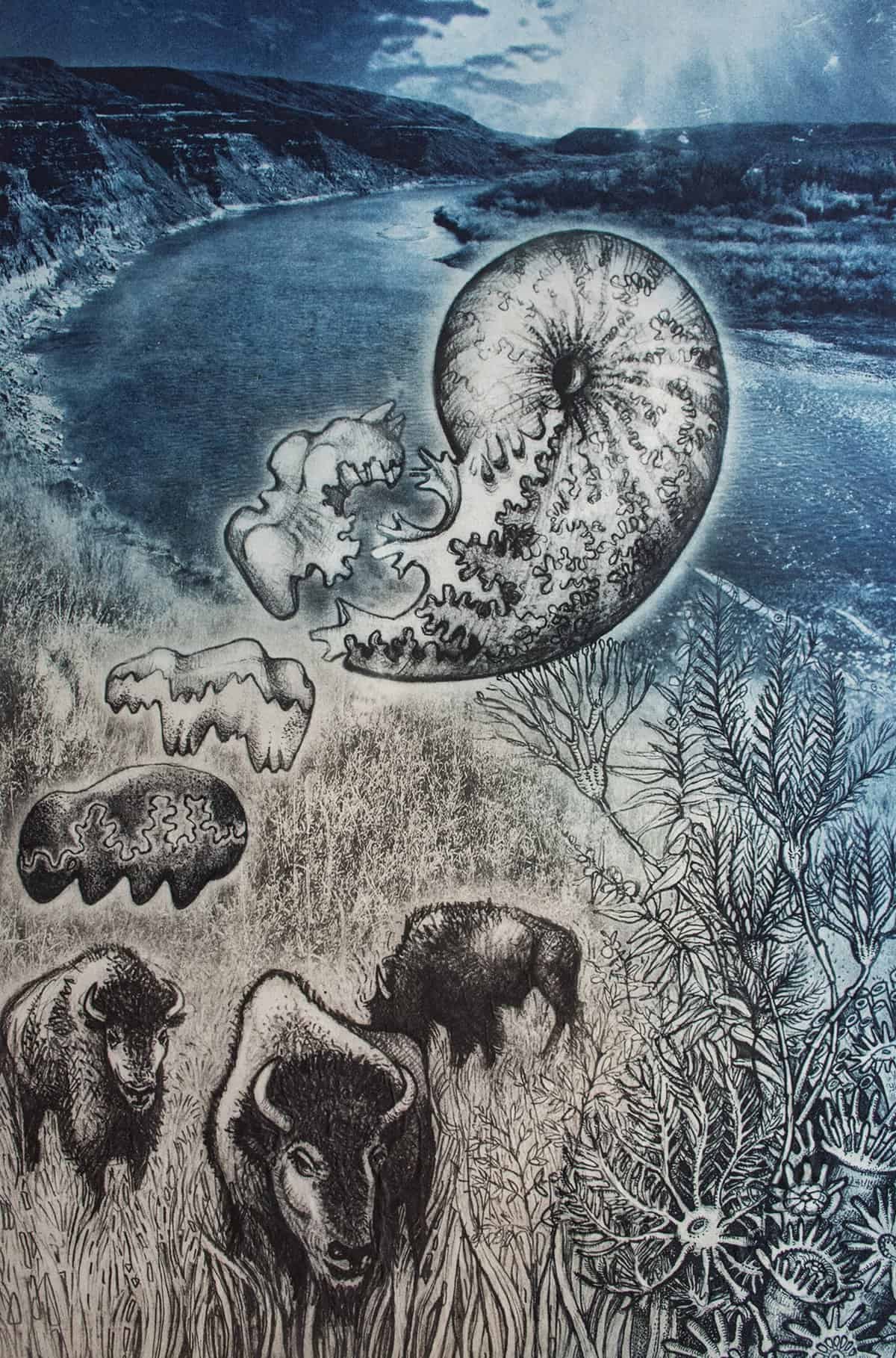
The piece depicts Iniskim as originating from a coiled ammonite, rather than the straight-shelled baculite from my story. This isn’t incorrect- ammonites share the same sutured chambers as baculites, and many other types of fossils such as corals, shells, and even dinosaur bones could be considered Iniskim.
Writing Process & Analysis
This story was written at a fair clip. I started writing it on December 22, and finished it February 15. I don’t think the story actually took more than a week and a half to complete, excluding all the days I ignored the manuscript to work on other projects. Over half of it was finished before January 1st, with the most outstanding element remaining being the bulk of Hedgepeth’s speech recounting his life as a buffalo hunter. This naturally took longer due to the need to properly convey the gravity of what he had done, and his own inability to confront his wrongdoing despite his deeper awareness of it. It was tricky to write.
I’m still not quite sure if I conveyed it correctly. Hedgepeth’s ranting was supposed to come off as nearly bipolar coping- “I needed money, but also the army wanted the bison gone to fight the Indians, but also the bison had to go anyway because of civilization, but also… I really, really needed money!”- to smooth over his true recognition that he did something he knows was deeply wrong. I’m mostly satisfied with the rest of the story, but as this is the scene on which the entire narrative hinges, if it fails the rest of the story would as well.
As is, I think it’s a serviceable short story. It may have benefited from another couple hundred words or so words, expanding on Yarnall’s and maybe even Gnaski’s character and perhaps giving Hedgepeth some more breathing room to tell his backstory. But for what it is, it’s alright. Someday I may return to this one and write that little expansion, and republish it in its proper perfection. We’ll see.
Overall, I find the story sort of wishful thinking. It’s something I think we all would like to have happened- the bad guys who robbed us before we were even born get their supernatural comeuppance. But, ultimately, out here in the real world, they didn’t, and the outcome was the same even in the story. Regardless of whether the hide hunters were punished, the bison are still gone. We are still deprived forever of the vast herds that drove John James Audubon to exultant conniptions when he first explored the Great Plains- “In fact, it is impossible to describe or even conceive the vast multitudes of these animals that exist even now, and feed on these oceanlike prairies.”
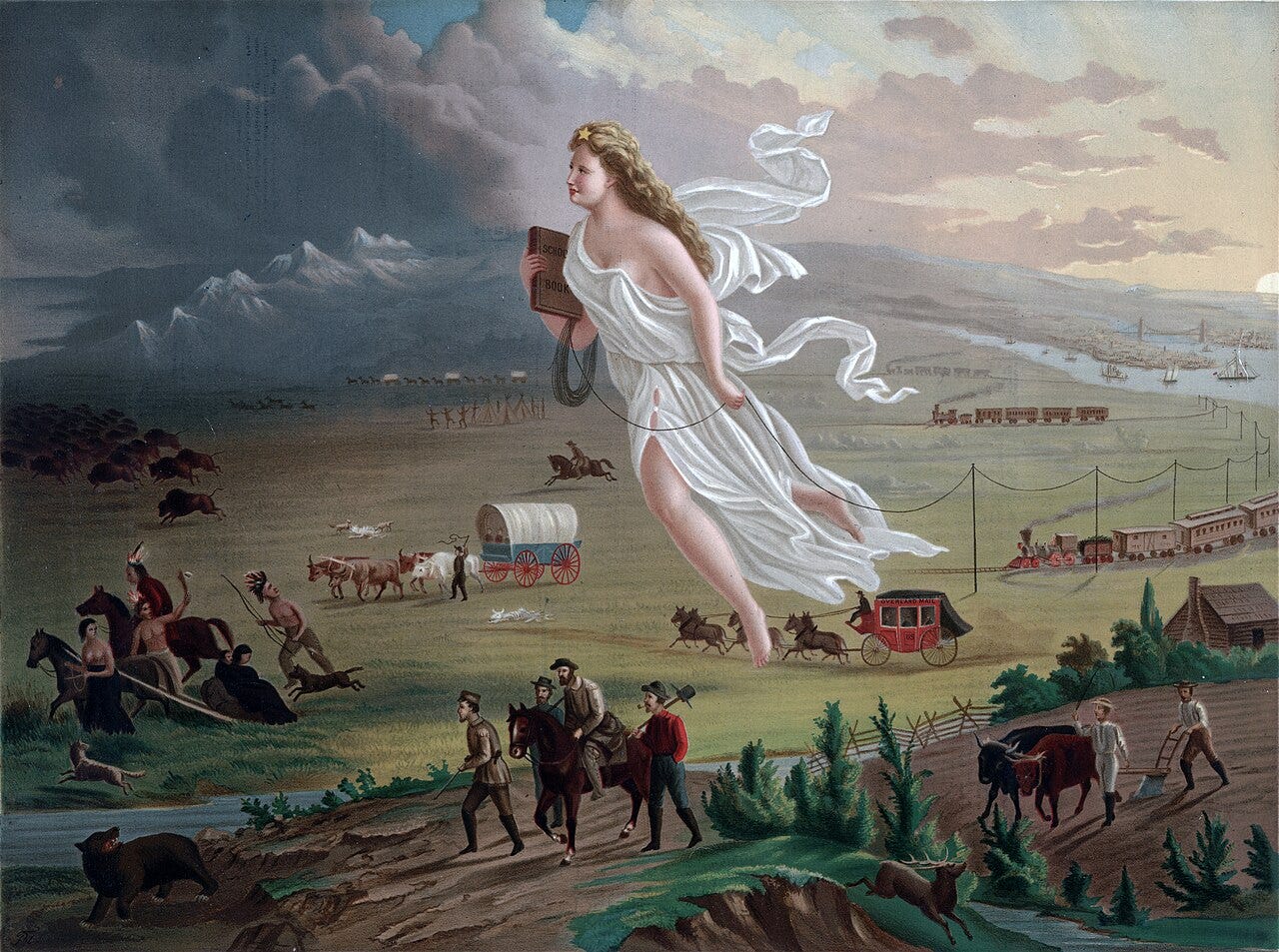
In one respect, Hedgepeth may have been right- the bison’s time is gone. They aren’t coming back, at least not while any of us draw breath. Nearly all of their former grazing grounds are either under the plow or occupied by cattle. Progress, as defined by that repugnant painting by John Gast, came, and saw, and conquered, and in its wake left behind a wasteland of corn and cows, built upon the bones of those nobler creatures who came before.
I hope- for those of you who made it this far- that this wasn’t too boring a read, or that it felt overly indulgent. I always enjoy when other writers and artists discuss their own techniques and inspirations, so I figure there’s a small chance you guys might enjoy hearing a bit about mine.
That’s all. You can go home now.
Including, lest I be accused of discounting the possibility of redemption, a former hide hunter named Charles “Buffalo” Jones. Overwhelmed by guilt over his participation in the slaughter, he singlehandedly spent three years searching every canyon and gulch in the Southern Plains for the last remnants of the vast bison herd that once dwelt in that country. He later became the first game warden of Yellowstone National Park.
Which naturally did not aid the species’ recovery from such severe hunting pressures
Imagine that. Instead of eating the animals they felled, at least sparing the tiniest bit of waste, they had bacon and jerky shipped out to them.
It’s also the source for the wonderful depiction of the iniskim process featured on the cover of this essay.
I completely disagree that you failed to properly convey Hedgepth’s monologue to try justify himself. It was the best part for me
I’ve meet a few Hedgepeths in my day. You capture the personality of that character perfectly I thought.